Tuesday, September 27, 2011

Interview with PJ Hoover, author of the MG fantasy, Soltice

Today's interview is with P.J. Hoover who has been an avid fan of Greek mythology since the sixth grade after reading the book Mythology by Edith Hamilton. But she didn't do the immediate jump to writing. Her first career was as an electrical engineer designing computer chips. So let's see how the writing career evolved.

You’ve just released your first YA book after doing a MG Trilogy. Why the change in genre? Will you still be doing MG books? Is the trilogy the end for that set of characters or do they have more stories to tell?
The way I look at it, I’m 41 years old which means I have lots of time for writing ahead. I want to continue to write both YA and MG (and maybe an adult novel here or there). I want to write a spin-off series for my MG trilogy. I want to write a sequel to SOLSTICE. Is it bad that I want to do it all?

As for why the change in genre, SOLSTICE was always a mythology story, and for what I wanted to do with the myth and the romance, the age had to increase. It would have been totally inappropriate otherwise.

What drew you to write MG and YA books? Prior to writing these books what previous writing credits did you have?
As for why the MG and YA market, truly I just wanted to write science fiction and fantasy. But when my first story draft was finished, I learned it was in some category called MG. And I went from there. When it comes to previous writing credits, there were a couple poems I wrote in my youth.

In all seriousness, I never thought of myself as a writer. I was an engineer, and thus very math and science oriented. Writing came in the form of technical documents. But I read like crazy, so once I started writing, it fit my personality perfectly.

When did you decide that you could write full time and leave your job of being an electrical engineer?
It was in April of 2008. By then, my son was in elementary school, and my daughter was in preschool, so being able to spend more time with them after school and cart them around to activities was top priority. My husband was actually the one to suggest staying home to write, and once the idea was planted, I seized the opportunity.

You’re part of a blog group called the YA Indie Blog Carnival which over the summer did a weekly blog train. It says that it is for Independent authors are those who have chosen to publish their written works independently of a traditional publisher or agent. Yet your trilogy was published by a traditional publisher. It is only with this last book, Solstice, that you went to the independent e-book format. Why the change?
I think in today’s publishing world and in the future, authors will publish both traditionally and independently. The trick comes, I think, in weighing each manuscript and deciding what is right for it and making the decisions for the right reasons. With SOLSTICE, timing was the main concern. There were a few key YA mythology stories coming out in Spring 2011, and I wanted to hit that window.

Will the blog train return again next summer? How did it begin? Can others join in for next year if there is one?
It’s on, and it seems to be a continuing thing, and I love being a part of it! I was asked to join by Laura Elliott (author of WINNEMUCCA), and we have new authors joining each week.

Since you have written for both traditional publishers and as an independent publisher could you give me some of the pitfalls or frustrations that you wished you had been aware of in advance?
Honestly, there are a million things authors could do “wrong” at any given moment. I think the best thing is just moving forward, asking questions when you aren’t sure about something, and making mistakes and learning from them. Each author is going to have a different path to publication, and so many paths can be awesome.

Can you give me an example of an Aha moment in your writing when things just seemed to fall into place and you felt this is what you’re supposed to do?
Well, it certainly wasn’t after the first ten pages. I thought it would take forever to finish a novel. But once the pages started accumulating, it dawned on me that, as long as I wrote consistently, I could write books forever.

That's it for today's interview. Here's some final notes on her books. Her first novel for teens, Solstice, takes place in a Global Warming future and explores the parallel world of mythology beside our own. Her middle grade fantasy novels, The Emerald Tablet, The Navel of the World, and The Necropolis, chronicle the adventures of a boy who discovers he’s part of two feuding worlds hidden beneath the sea.

If you would like to learn more about her writing and buy her books go to http://www.pjhoover.com. You can also see her book trailer at http://www.youtube.com/watch?v=fkWezTGdTkg

Saturday, September 24, 2011

Coming to a New Home

Lately I've been on an emotional roller coaster due to lack of sleep and the stress of moving (thus the sleeplessness). Each time I fill a box and seal it there still seems to be just as many more boxes to do. It's like trying to dig a hole in soft sand where it continues to refill itself. But I know it will soon be complete as the moving van comes on Tuesday morning and my packing time will be up.

I've lived in this town for 25 years and we've had one big going away party and two smaller ones. It's bittersweet saying goodbye to good friends. I know I can still keep in touch via email - which is what most of our relationships have been like lately. Everyone is always so busy and email is sometimes the only way we stay connected even when we live just a short distance apart.

I hope to change that when I make new friends in my new state. We're moving from California to Texas from a town of 210,000 to one that is 18,000. Big difference. I've only seen my new home briefly in pictures on the internet. It was pulled off the internet once we signed the lease and my husband didn't take pictures while he was there. So now I ponder what I will find in the home's layout and making the big decision as to where to put all our stuff.

As to coming to the new home I'm both anxious and excited but mostly tired and wondering when I will be able to relax again. Packing has been a full time job for me the last month amongst my other work and chores. Once in the new home there will be unpacking and studying.I've been taking online classes and will continue to do so once we arrive so I can complete my training for a new career. As tired as I am doing this extra work for just one month, I wonder how others hold down two jobs. You've got to start feeling like a walking zombie.

It's said home is where the heart is and as long as I'm with my husband I know I can survive and thrive. In my new community I will also draw from a new group of friends and a new supportive church home.

I may have thought this would have been the community where I would live through retirement and use as a launching pad for extensive travel but my destiny changed. It's all part of God's purpose and His plan. Through all my ups and downs He has been with me and will continue to be.

What has been a great help for me through the turmoil of this year is a song called "Blessings" which has great lyrics and here's the link for the actual song. But for now I will end with a few of the lyrics...

What if Your blessings come through raindrops
What if Your healing comes through tears?
And what if a thousand sleepless nights
Are what it takes to know You're near?
And what if trials of this life
Are Your mercies in disguise?

This has been my monthly post for the CW blog chain with the topic "Coming Home". If you would like to read others thoughts on the topic click on the link to the right of this post.

Tuesday, September 20, 2011

Interview with Mike Mullin, author of the YA thriller, Ashfall

How did you come up with the idea for Ashfall? What drew you to writing for the YA genre?
I write young adult novels because that’s what I’ve been reading for the last 30 years. I grew up reading Blume, Peck, and Cormier and never quit. It helped that my mother was a librarian and later a children’s bookstore owner. I worked in her bookstore off and on for more than twenty years, and I’m still occasionally involved.

The idea for ASHFALL started with a trip to Central Library in downtown Indianapolis. They had a display that included Bill Bryson’s A Short History of Nearly Everything. It was the big, lavishly illustrated version, but it still didn’t seem weighty enough to cover nearly everything. So I checked it out, determined to discover what hubris had led Bryson’s publishers to select that title. When I got to the section on the Yellowstone super-volcano, I was hooked.

Could you give my readers a short synopsis of the story?
Sure, ASHFALL’s about a teenager struggling to survive and find his family after the cataclysmic eruption of the Yellowstone super-volcano. Alex faces darkness, ash, bandits, and desperate refugees during a perilous journey across northeastern Iowa on foot.

Since this is your first book let’s talk about the process. How many publishers did you contact to produce your book? Did you contact any agents?
ASHFALL was rejected at some stage—query, partial, or full—by 24 literary agents. If you’re struggling with getting published, take heart from this. Yes, your work might not be ready. But it might also be great work that simply hasn’t found a champion.(Take a look at the list of awards and blurbs at www.mikemullinauthor.com, including a starred review from Kirkus.)I’m pretty confident that ASHFALL wasn’t garnering rejections due to its quality.)

Two publishers requested ASHFALL after hearing about it from my mother. (She owns a children’s bookstore, remember?) I haven’t heard back from one of them yet. The other was Tanglewood Press.

From the time you sent in your manuscript to your Tanglewood Press how long was it before you got any feedback?
It was about two weeks before I got “The Call.” That conversation basically boiled down to, “I love ASHFALL, I want to buy it, but you have to fix the ending.” So, luckily for my readers, I did fix the ending. Six times. It was a bit harrowing while I was in the middle of the process, but now I’m grateful to my editor at Tanglewood for continuing to push me. She knew I had something better inside, struggling to make its way out onto the page.

What type of publicity do you expect your publisher to do in promoting your book?
Honestly, I expected they’d do very little. I’ve been thrilled to discover that’s not the case. Tanglewood placed ASHFALL on NetGalley, printed more than 500 ARCs, gave me several cases of ARCs to use in promotions, gave me twice as many hardbacks as my contract calls for (again, for promotion), placed a full-page ad in Publishers Weekly, flew me to New Orleans for the American Library Association convention . . . and that was just what they did in June and July of this year. Monday (9/19), I’ll start a book tour that will include three bookseller shows and more than 100 library, bookstore, and school appearances stretching from Rhode Island to Iowa and lasting until mid-December.

It sounds like you will be really busy.Tell me about that experience.

I’m about as stressed out as I’ve ever been in my life. I have to keep reminding myself to breathe and relax. I know I’ll be fine once I’m in the middle of it—I’m an excellent and practiced public speaker—but right now it feels overwhelming. I’m also gaining weight, which is not acceptable. Grr. More exercise, less food. But that whole internal conversation isn’t helping my stress level either.

I’ve put a lot of effort into social media, amassing more than 17,000 followers on Twitter, Goodreads, Facebook, and Google+, but I’m not completely convinced that’s been the best possible use of my time. I know I’ve reached a lot of book bloggers, writers, librarians and teachers there, but I’m not reaching much of my target audience: teens.

It’s possible that I would have been better off skipping all of those channels and focusing on YouTube and Tumblr instead, but I’m naturally more of a writer than a visual person, so those channels are outside of my comfort zone. It’s something I need to give some more thought to and possibly adjust in my marketing.

What surprised you about the published process in a good way?
Tanglewood Press’s promotional effort has been a massive and welcome surprise. I fully expected that ASHFALL would be thrown out there like many small press and midlist large-press books are—with very little support other than what the author provides.

What has been the most frustrating part?
That moment when the manuscript left my control was really hard. I know indie authors have a hard row to hoe marketing-wise, but I’m jealous of their ability to constantly tweak and improve their work. Going in, I didn’t realize how much dread I’d face when ASHFALL went from a file on my computer that I could tinker with anytime to a PDF file on Tanglewood’s computers and then into a printed book that can’t be changed at all.

What do you wish you had known earlier?
When I was querying agents, I didn’t realize how difficult it is to sell a young adult novel with a male protagonist. I mean, I knew it was tough in the bookstore, and that most YA sells to girls, but I never made the logical leap to the idea that publishers wouldn’t be seeking male protagonists.

So I internalized too many of the literary agent rejections as “Your book sucks” instead of what they were really saying, which was, “We’re not sure we can sell this.”

What is the best piece of advice that you have received about writing?
Jim McCarthy of Dystel and Goderich offered some generous advice: to add more tension and emotion to my story. ASHFALL improved as a result, and he’s the only literary agent I thank in the acknowledgements.

What advice would you give to other writers for encouragement?
If you pursue this career, you can read, write, and talk about books all day and call it “work”. What’s not to love? My number one piece of advice to other writers: read. Read a lot. No, read even more than that.

Reading is how you learn what works and what doesn’t, and how you discover whether your story ideas are fresh or clichéd. You need to read deeply in your genre of choice and broadly outside it.

If you'd like to learn more about Mike's book tour or his writing go to his website where you will even be able to read the first two chapter of Ashfall. Here's the info www.mikemullinauthor.com. In addition, here's some links if you would like to buy the book...here's a direct link to Amazon or Barnes & Noble

Tuesday, September 13, 2011

Interview with Clyde Edgerton, Author and Southern Raconteur

I'm not one for holding on to books. I usually read them and then donate them to the library. However, I do have a few favorites that I will not give away. One of them is a novel entitled Walking Across Egypt. It's a novel that is full of southern charm and the joy of home cooking. If you haven't read it, you need to pick it up. My interview today is with the author of that book, as well as nine others. He has been a Guggenheim Fellow and five of his novels have been New York Times Notable Books. He is a member of the Fellowship of Southern Writers and teaches creative writing at UNC Wilmington.

Let’s go back to your earliest novel, Walking Across Egypt, which is one of my favorite books. It was first published in 1988 and was then re-released in 1997. How much did the movie increase sales?
I'm glad you liked that book. It's sold better than any of the others. I'm not sure if the movie increased sales. Because the movie never went to theaters I'm thinking maybe not. But I've not been able to track sales figures in any precise way.

Tell me about the process of what it took to go from a book to the screen.Who initiated the quest? How much input did you have in the movie script? What surprised you most the process? How did the process change with your other novels being made into movies?
A filmmaker from Nashville, Madeline Bell, approached me, and worked for four years on getting the film made. It was finally made, thought in order for that to happen Madeline lost much of the control. I was asked to look at the script for minor problems with speech, etc. I was not surprised by much during the process. It was exciting to think about the story appearing on screen. I only saw about 40 minutes of Raney. I never had an opportunity to see that one. Killer Diller was great fun because I knew the director and scriptwriter, Tricia Brock. She let me critique the script and play a bit part. I think it's the best of the three.

You’ve also had stage adaptations made from your books. Which results do you like better the plays or the movies?
I like the plays better. They are flexible and change with each production. The plays have been great fun, especially my working on the musical Lunch at the Piccadilly with musician Mike Craver. We went back and forth for two years on email writing that thing--2004, I think--and have had great fun with it since. Steve Umberger is working on setting up a tour which I hope happens in the future.

You’ve now published 10 novels and had movies and stage adaptations done of those books. What keeps you still teaching creative writing?
I teach to make a living--and I'm lucky that I enjoy it. I made a living from 1988 to 1998 as writer only, but I needed the added security of a steady job that paid health insurance etc. as my oldest daughter prepared to go to college, so I went back to teaching.

What do you tell your students who want to be famous writers? What is one of the most rewarding moments you’ve had as a professor with your students?
I tell my writing students to follow no advice that doesn't make sense to them and to try to understand what the story they are writing is about so that they can better revise. One of the most rewarding moments I've had as a professor was seeing a book by one of my less talented(but very hard working)students published.

What have you learned from your own writing experiences that you have incorporated in your teaching as tips for aspiring writers?
I think my answer above--take no advice that doesn't make sense to you and know what your novel is about(this may change during revisions)--are two lessons I've incorporated into my teaching. There are many mini-lessons: help the reader see the action by picking just the right details; get two people into the story as soon as possible(since much literary fiction is about relationships between characters); minimize flashbacks; minimize adverbs and adjectives; realize that you have three main tools in getting plot and theme: your experience, your observation (of the experience of others); your imagination. When one tool isn't working all that well, try either of the other two.

Do you remember the first piece you had published? Can you tell me about it? At that point did you really think you would go on to publishing books?
My first publication was a story published in my high school newspaper. It was about an adventure that two other students and I had when during biology class when we released a tadpole into a creek down in the woods (We begged the teacher to let us do this) and then "lost our way" back to school. We missed about an hour of class wandering in the woods.

I thought we'd get punished when we returned to school, but rather, my English teacher asked me to write about the experience for the school newspaper. When I saw the story in print and realized that it was funny as I'd hoped it would be, I was smitten. At that point I didn't know what I wanted to do in the future.

Later when I stumbled onto Flannery O'Connor's and Eudora Welty's stories, I realized I had plenty of experience as an only child with twenty-three aunts and uncles to make up stories from. When I later saw that the stories could be molded into novels, I thought I might have a chance at publishing a book.

Your new book is entitled, The Night Train, which is about musicians. When I read the trailer, it made me think of the movie, The Commitments (an Irish band who plays the blues like James Brown). What inspired you to write this book?

I never saw the Commitments, but I will now. I was partly inspired to write the book as a consequence of joining a band in 1963 (I was nineteen). The lead singer (white, as were all of us) wanted to be James Brown. When I joined the band (The Seven Keys) the band was learning Live at the Apollo, Brown's famous 1963 album that was played as a single song (there were no breaks between the eleven songs). My experiences in this band and another rock and roll band I was in prior to this one helped inspire the novel.

What type of music do you play?
I play piano and harmonica on the vimeo trailer--that gives a hint. I play some blues piano, a tinkering of jazz, some bluegrass banjo and I sing some original folk-country songs.

Here's the link to that trailer http://vimeo.com/25265338. If you would like to learn more about Clyde Edgerton's writing go to http://clydeedgerton.com. And if you're in the Wilmington, North Carolina area you might consider taking one of his classes.

Tuesday, September 6, 2011

Interview with ML Archer on her fantasy book, The Calling of Mike Malone

You’ve just had your first book published entitled, The Calling of Mike Malone. Tell me how that came about.
The foundation for Mike Malone began years ago and grew out of an interest I'd had in the prophet Enoch. I'd known about him being 'translated' and taken to heaven by God since I was a little kid. But I never knew anything else about him. Even the Bible is very quiet about this prophet, and yet Hebrews 11:5 tells us this:

“By faith Enoch was translated that he should not see death; and was not found, because God had translated him: for before his translation he had this testimony, that he pleased God.”

The only other person of whom God says He was pleased is Jesus Christ, so I think it's only natural to ask yourself how Enoch earned such praise. Long story short: I read the book of Enoch. Enoch lived a good life and honored God.

When I found myself teaching 4th grade and had a bunch of boys in my class who hated reading, I asked them, “All right, if you only want to read the kind of stories you like, then tell me what that story is and I'll write it.” Their answers were amazing. They wanted a very clear 'good-guy' and 'bad-guy'. There had to be fighting, a sword or two might be good, and maybe a dragon. There had to be strange or dark powers at work. There could be a girlfriend, but no love scenes. Also, if I could manage scientific, inter-dimensional travel, that would be good, and...and if there was a hint that maybe it could all be true, even better.

How many publishers did you contact before going with MuseItUp?

Oh, my goodness! About thirty. I would have sent it many more places if I had had the time. But the responses back were all very encouraging. They would say things like, “I feel as if I'm letting the wrong story get away, but financially, we have to go with...” and they would briefly state one thing or another. Those were from the secular publishing houses.

The most difficult, and critical houses were the ones in the CBA. (Christian Bookseller's Association.) I had a tough time trying to figure out what they hated more, the story or the doctrine or the language. The comments were very disappointing, such as, “You show a Catholic priest having more power than the Protestant pastor. Our readers won't like that.” And there were always comments about why didn't I know fallen angels were really demons...etc. Excuse me, they are not the same. I know the CBA does hold an important role, but not for me.

Did you contact any agents?
At least fifteen. Most of them sounded interested but were concerned over taking on an unknown in the sort of economic environment we were heading for. But their opinions were encouraging!

Prior to writing this book what other author credits did you have?

I wrote short stories. My favorite is a story I called, “Ellie.” It appeared in Fear and Trembling, a Christian Horror publication, where it received the following warning label...

“NOTE: This story contains content that may not be suitable for young readers, but it contains a message of caution for those who are mature. It is published as a warning, as an example of how dark some lives become when they ignore the Light.”

A warning label...in a horror magazine! 'Kinda makes ya proud! Feel free to check out Ellie at my on line portfolio right here.

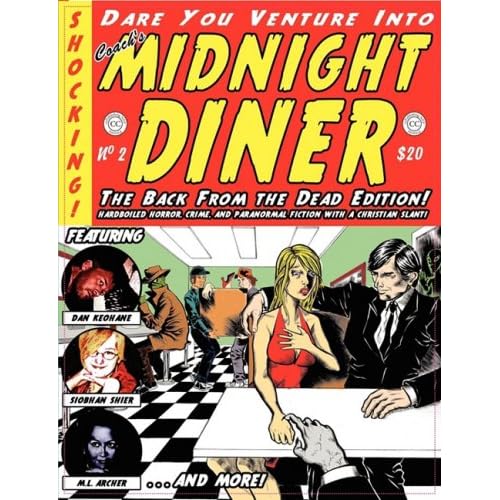
You wrote a short story about a violinist,entitled Paint it Black. You say it, won an Editor's Choice award and was published in Coach's Midnight Diner. Can you give me some more details?
What attracted me to the Diner was this description of itself posted at the old website:

“The Midnight Diner is a hardboiled genre anthology with a Christian slant. No ABA restrictions on God, no CBA restrictions on reality. Didactic preachy works are dismissed unceremoniously; we're looking for high quality works that are uncompromising in craft, content, and quality.”
Sounded like my kind of people and a fine challenge. The story was about a violinist trying to find out how his brother died. It sort of mirrored my life at the time because my brother's dead body had been discovered floating in a local canal and no one ever found out how it really happened. So I wrote a story.

It appeared in their “Back from the Dead” issue. Of the many stories used for the anthology, mine and two others were 'Editors Choice' recipients. We received cash awards and elements from all three tales were used on the cover here, along with pictures of the authors. That's me in the bottom circle. Also, my story characters are sitting at the front table with the ET face peeking in the window at them.

What was your biggest surprise about the whole publishing process?
Editing! It's tough to look at a returned manuscript with edits and not think, 'Whoa! I write like a blind wolverine!' But I'm still learning. I have noticed the parts that don't resemble a crime scene are the places where I've stepped into the story and stayed there.

Now if other things in ones life didn't also have to happen like making dinner and cleaning the house, the poor editor wouldn't have so much work to do. And I can be very bad about writing the story I think someone else might like, or one that might suit the standard, and then it becomes very manufactured sounding, at least to me. And then the editor really has her work cut out!

And when you are working with an editor, here’s my best advice: Shut-up and listen. They are your best friend striving to help you polish a work in order for you to succeed. I'm not kidding, there should be an “I Love Editors Day,” celebrated by published authors everywhere.

Tell me about your publisher, MuseItUp
MuseItUp is a Canadian based, traditional, royalties paying publishing house. Because they deal in e-books first it's easier for them to take a risk on brand new writers and different ideas. And they do it with great aplomb! Whatever your preference in stories you can find it at MuseItUp. The goal is quality fiction and they certainly have it!

It's a fantastic company. The founder is Lea Schizas, a woman who cares very much about writers. Lea has been in the writing business for a number of years. She's edited for several publishing houses, her websites have been mentioned in Writer's Digest top 101 writing sites and won several awards in various categories in the Predators and Editors annual voting polls.

Lea is the most caring and supportive publisher I've ever seen. And the editors and artists working with her are the same way. It's a great organization and I'm pleased to be a part of it.

Let’s talk a little about the book. On your blog you write that Mike Malone has to deal with the fact that his father’s greatest dream for his life is to have Mike become own his anti-Christ. Tell me more.
Well, Mike Malone is a guy caught in extraordinary circumstances. He does very well in life, has a lot going for him and then total insanity breaks out when his father, a fallen angel, who stepped out of Mike's life years before, decides to come back. His father, Ahiel, has a goal of usurping power from Lucifer and taking over himself. To do this he needs an anti-Christ, and he's not above forcing Mike into the role.

Mike soon discovers, among other things, that Ahiel lies when his lips move and that he will stop at nothing to get what he wants. Mike can see that his father is dangerous and evil, and yet he still has memories of his childhood when his dad was this wonderful loving father, one that Mike would have died for. And by the end of the story, we find out that Ahiel, in his own perverse way, passionately loves his son. In another world the two would have been inseperable, but Ahiel's sin has made that impossible.

The story has a happy ending, but at the heart of it is this tragic situation.

What author(s) inspired you to write this type of book?
Robert Heinlein. I was always a sucker for his space opera's and big drama. And as ever…Madeleine L'Engle.

Will this be a stand alone book or do you plan for it to be part of a series?
I left the story so that it could become a series. Just might turn out that way.

What do you know now about publishing that you wished you had known sooner?
I'm not sure if there is one particular thing. I will say quality is everything. When you think your manuscript is ready, find a critique group or at least someone unfamiliar with your work and have them read it and tell you what they think. The more honest the better. If their suggestions sound as if they might improve your product in the slightest way, use it and be thankful.

I don’t have a critique group in my area. I'm in MuseIt's author's group now and it's been helpful already.

If you would like to pick up a copy of the book, click here.

If you would like to learn more about MuseItup,here's their link...
http://museituppublishing.com/