When she's not writing, you may find her as a featured speaker at libraries, conferences, and community events. She is listed in Contemporary Authors, Poets & Writers, and Who's Who in U.S. Writers, Editors, & Poets. So let's move on to discover what makes her such a success.
Your early books were science fiction romances which are quite different from the cozy mystery series you have been writing for a number of years. What it hard to transition from one genre to another?I was already putting a mystery into my romances when I switched to writing a cozy mystery series. So the plotting process was similar, although the focus shifted. Instead of a romantic resolution coming at the end of book one in my mystery series, the romance subplot had to happen a lot slower and with much more subtlety.
The biggest change was marketing to a different audience. Going to my first mystery conference was like being exposed to a new culture. Different expectations and genre conventions came into play. I had to cultivate an entirely new readership. So that was the hardest part of switching genres.
What makes for a good mystery? Tell me about the process.
Usually, I start with the victim. Then I decide who might want to kill him. The suspects get fleshed out with motives and secrets, and then I relate these people to each other. Often the one with the strongest motive becomes the killer. Or this person might make a better red herring. At this point, I’ll write a complete synopsis. The story might change as I write it, and that’s okay. Then I’ll go back and revise the synopsis accordingly. I may also keep a chapter-to-chapter outline to help me keep track of days of the week and who said what in previous scenes. The objective is to trick and distract the reader enough to keep her guessing until the end but to provide clues for fair play. Your readers want to solve the puzzle along with the sleuth.
What type of research do you do for your books?
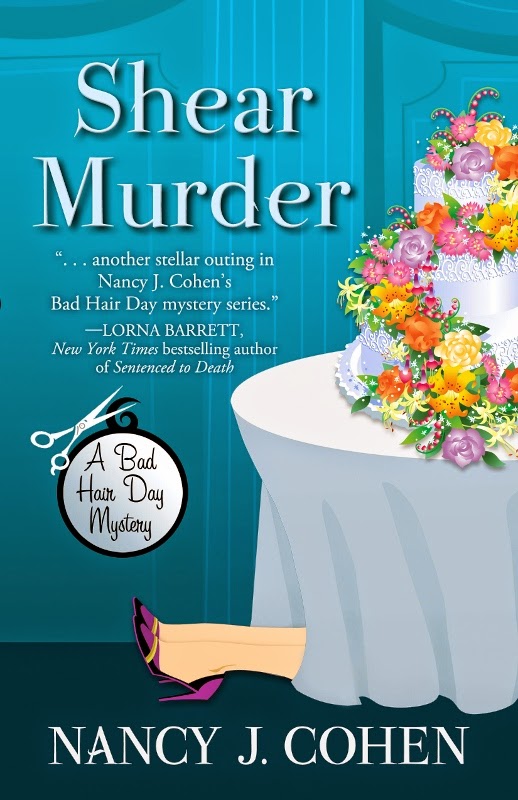
 I do research as needed while I’m writing. The research might involve a particular setting or merely an interesting topic I address in the story. Recently, I’ve been looking into acacia trees and their role in Egyptian mythology. I’ll also include local issues, such as children dying in hot cars in Florida. It gives me a chance to educate the public on preventive measures. This appears in Hair Brained, my Sept. 12 release and #14 in the Bad Hair Day series. My hairstylist sleuth, Marla Vail, learns about this topic while she’s interviewing suspects. After I finish my first draft, I’ll do two or three more sweeps for editing and polishing.
According to your bio, you are active with 6 writing groups. How do you find the time to be part of all these organizations? What would you tell other writers is the best reason to be active with writing groups?
It’s incredibly important to belong to professional writers’ organizations and participate in their online Yahoo groups. I learn so much about the business aspects of writing from other authors. Locally, I attend two meetings a month, once with romance writers and the other with mystery writers. I’ll attend national conferences depending upon the location and cost. You can’t write in a vacuum. It’s imperative to get connected with the writing community. You’ll make friends, find critique partners, and engage with like-minded individuals who love writing like you do.
What do you think the biggest error that new writers make in creating their first cozy mystery?
You need to give the heroine a personal motive to get involved. Just making her curious and nosy isn’t enough. If the stakes are high for her, your readers will care more deeply about what happens. So give her a strong motive to get involved. Also, give her the skills to solve the murder on her own. You can’t have her rely on the hero or on a force of nature to get her out of a fix. As in any first novel, backstory and flashbacks should be kept to a minimum. Keep the story moving forward with less expository passages and more dialogue and action.
How do you write? Did you do an outline first? Did you do individual character development before doing the full plot?
First I determine the setting, victim, and suspects. I’ll do profiles on these people so I can start to get to know them. Once these are set in my mind, I write a synopsis. Then the actual writing begins. The synopsis acts as my guideline, but that doesn’t mean I have to stick to it. Things change, and I’ll revise the synopsis to match the story. It’s easier writing a series because you already know the recurrent characters. So mainly I have to create a new cast of suspects for each mystery. They’ll each have a secret and these people will be interrelated, although their connections won’t be evident until later in the book.
What type of publicity do you do to promote your book? What has worked best for you in generating sales?
For a book release, I’ll do an online blog tour (next one starts on Sept. 12), a Goodreads giveaway, Rafflecopter contests, in-person signings, conference workshops, a book launch party on Facebook, and frequent social media posts. On release day, I’ll send out a newsletter to announce the new release as well as a blog post. As for what works best—who knows?
What do you know now about writing/publishing now that you wished you had known sooner?
Stick to what you like to write and build up your repertoire. If I’d known this, I might not have switched genres back and forth. But at the time, indie publishing wasn’t available, and you had to write what would sell.
What makes for a good mystery? Tell me about the process.
Usually, I start with the victim. Then I decide who might want to kill him. The suspects get fleshed out with motives and secrets, and then I relate these people to each other. Often the one with the strongest motive becomes the killer. Or this person might make a better red herring. At this point, I’ll write a complete synopsis. The story might change as I write it, and that’s okay. Then I’ll go back and revise the synopsis accordingly. I may also keep a chapter-to-chapter outline to help me keep track of days of the week and who said what in previous scenes. The objective is to trick and distract the reader enough to keep her guessing until the end but to provide clues for fair play. Your readers want to solve the puzzle along with the sleuth.
What type of research do you do for your books?

According to your bio, you are active with 6 writing groups. How do you find the time to be part of all these organizations? What would you tell other writers is the best reason to be active with writing groups?
It’s incredibly important to belong to professional writers’ organizations and participate in their online Yahoo groups. I learn so much about the business aspects of writing from other authors. Locally, I attend two meetings a month, once with romance writers and the other with mystery writers. I’ll attend national conferences depending upon the location and cost. You can’t write in a vacuum. It’s imperative to get connected with the writing community. You’ll make friends, find critique partners, and engage with like-minded individuals who love writing like you do.
What do you think the biggest error that new writers make in creating their first cozy mystery?
You need to give the heroine a personal motive to get involved. Just making her curious and nosy isn’t enough. If the stakes are high for her, your readers will care more deeply about what happens. So give her a strong motive to get involved. Also, give her the skills to solve the murder on her own. You can’t have her rely on the hero or on a force of nature to get her out of a fix. As in any first novel, backstory and flashbacks should be kept to a minimum. Keep the story moving forward with less expository passages and more dialogue and action.
How do you write? Did you do an outline first? Did you do individual character development before doing the full plot?
First I determine the setting, victim, and suspects. I’ll do profiles on these people so I can start to get to know them. Once these are set in my mind, I write a synopsis. Then the actual writing begins. The synopsis acts as my guideline, but that doesn’t mean I have to stick to it. Things change, and I’ll revise the synopsis to match the story. It’s easier writing a series because you already know the recurrent characters. So mainly I have to create a new cast of suspects for each mystery. They’ll each have a secret and these people will be interrelated, although their connections won’t be evident until later in the book.
What type of publicity do you do to promote your book? What has worked best for you in generating sales?
For a book release, I’ll do an online blog tour (next one starts on Sept. 12), a Goodreads giveaway, Rafflecopter contests, in-person signings, conference workshops, a book launch party on Facebook, and frequent social media posts. On release day, I’ll send out a newsletter to announce the new release as well as a blog post. As for what works best—who knows?
What do you know now about writing/publishing now that you wished you had known sooner?
Stick to what you like to write and build up your repertoire. If I’d known this, I might not have switched genres back and forth. But at the time, indie publishing wasn’t available, and you had to write what would sell.

Writing is an ongoing journey. We never stop learning and improving. If you stumble, pick yourself up and carry on. The only way to never get published is to quit.
What other works do you have in the process?
I’m currently working on Trimmed to Death, # 15 in the Bad Hair Day Mysteries. I am also continuing with my revised backlist mystery Author’s Editions. The first three titles in my series are in audiobook, so I’d like to continue with these as well.
Are there any other points you’d like to cover?
Please support your favorite authors by writing reviews of their books at online sites. On Amazon especially, the number of reviews counts toward algorithms that Amazon uses to recommend books to new readers. All you need to do is say a few words about why you liked a story and post a customer review. It means a lot.
That's all for today's interview. I hope it has piqued your interest to learn more about Nancy's writing. Here are some ways to do that.
Sign Up for her Newsletter! There's a free book sampler for new Subscribers: http://nancyjcohen.com/newsletter/
Website: http://nancyjcohen.com
Blog: http://nancyjcohen.wordpress.com
BookBub: https://www.bookbub.com/authors/nancy-j-cohen
Audible: http://adbl.co/2gMlVw1