Blog Archive

Showing posts with label writing kids chapter books. Show all posts

Saturday, June 29, 2024

Creating a Niche in Chapter Books: Author Interview with David Horn

What made you choose writing books for middle-grade readers? How do you determine the length and vocabulary for this age group?
I started writing at the chapter book level when my kids were at that reading level. At that age, once you got through the big series, I felt like there wasn’t a lot of variety for a voracious reader. And at the same time I was telling them stories at dinner, just to make them laugh, so I decided to try writing a chapter book. 

My first draft was terrible, but I learned through doing about the right word count and chapter lengths that worked better for young readers. For example, when I got the first paperback author pre-release version of my first Eudora Space Kid book, I realized some of my paragraphs were way too long and took up the entire page – very bad. So I quickly made everything shorter. But I didn’t’ realize it until I went to print. So there was a lot of learning by doing.

When you wrote your first Eudora Space Kid book, did you plan on making it a series? You have 5 books in that series. Will there be more?

At the time, I definitely thought it could be a series, since I had a word document with all the stories I ever told my kids jotted down (brief paragraph synopsis really). So when Eudora Space Kid Book 1 did okay, I decided to keep going. There are still stories on my document I haven’t written or released yet, even if my kids are well out of chapter book age now. In fact, I plan on starting art on Eudora Book 6 (a super-special type book) in the fall.

How did you go about finding an illustrator? 

I think you can find an illustrator in a lot of ways – SCBWI, any gigging sites, general search. My advice is that the cover is most important – they’ll never even see the insides if they don’t like the cover. Like picture books, chapter books have an assortment of images inside the book, but mostly are black and white sketches (that saves a lot in printing costs). However, the illustrator will also need to be able to do a full color cover. 

What advice would you give for finding an illustrator?

One thing I learned, which I didn’t know at first, is to go through your manuscript and mark where you think interior pictures would be good and then describe them as much as possible (I use comment bubbles for this). Then you can count them up and know you need a certain number of illustrations. You may have an idea what size you want them too. It’s easier to price out illustrators if you know how many pictures you need.

 You’ve now written two re-imagined fairy tale books from a contemporary viewpoint. What inspired you to make Sylvia Locke as a new vision of Cinderella?

Sylvia Locke also started out as stories I told my kids when they were at the chapter book age. They asked for a fairy tale for some reason, and I couldn’t just use Eudora, so I told a story about what happened after Goldilocks and the Bears had set all these traps for the next intruder – and it ended up like a Home Alone type story. Sylvia Locke started out as Goldilocks cousin, who was even worse than Goldilocks. When I started actually writing it out, I somehow lost the cousin thing and it just ended up with the bears moving.

And then my kids wanted to hear more about Sylvia Locke. So in the next story I told them, it just factually made sense that after breaking into a neighbor’s house her grandparents would send her away to live with other family who could actually watch over her, and it just became Cinderella.

I still tell my kids stories sometimes, and they’ve even heard ridiculous crossovers of Eudora and Sylvia.  

Are there other fairy tale characters ready to make their debut in other books?

Because I have this neighbor of Sylvia’s do a prologue and epilogue, I think he always gives a hint as to what the next story will be. I imagine Tairy Fails to be a serialized walk-through of all these fairy tales that Sylvia just happens to live through. Book 3 is supposed to be Rapunzel and I’m working on the manuscript now. I’m hoping to get Sylvia under water for the Little Mermaid at some point too. Haha.

How do you market your books? 

Because I’m only self-published, the marketing is hard. I try anything and everything to see what sticks, but I’m finding it’s all hit or miss anyway. 

 What is the best marketing/publishing advice you’ve received or could give?

Unfortunately, the best thing is just Amazon reviews. The more you can get, the more readers think your book is legit. But how do you get them consistently? I’ve been trying ARC sites more geared for self-publishing which have been okay.

Are there any other points about writing you would like to add?

Chapter books are hard! A lot of work for a small segment of the population and a lower price. You have to really love it. 

Give me a short synopsis of your latest book release or upcoming one.

I’ve actually been trying my hand at a few YA manuscripts and I hope to have some out later this year. And, like I said, Eudora Space Kid #6 will be out next year hopefully, and the working title is Admiral Eudora – so she gets a promotion in that one. Haha.

Tairy Fails #2 is out September 3 and the synopsis is: Fairytale Land's baddest girl is about to head to a prince's ball. A modern, twisted retelling of Cinderella. Perfect for elementary school kids and early chapter book readers.

That's all for today's interview. I encourage you to get some of David's books. I'm already a fan and a reader of his works. Here are a couple of links to connect you to his writing. 

And here's a bonus for my readers, leave a comment on this post and we'll pick one reader who'll receive an eBook copy of Tairy Fails Book #1. So do that now. It can be as simple as I want to be in the giveaway. We'll chose a winner next week! 

Tuesday, September 6, 2022

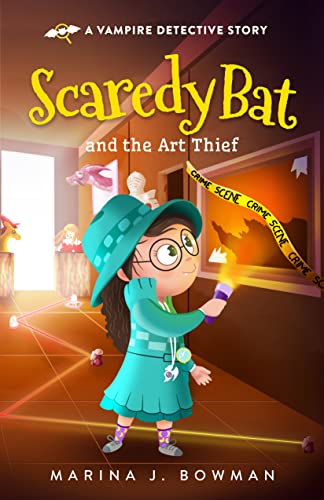
Don't Get Stuck in Analysis Paralysis: Author Interview with Marina J. Bowman

In reviewing your publishing history, I see you’ve published 10 books so far. What drew you to write children’s chapter books? 
When I was a child, I struggled to focus on books because I preferred to be outside, exploring magical new worlds. With help from my parents and teachers, eventually I realized that there are new worlds to explore and adventures to be had on the page as well as off the page. I was drawn to write children's chapter books because I wanted to help young readers (especially reluctant readers) fall in love with reading and become lifelong learners. And the most critical time for kids is the gap between picture books and full-length novels. 

When I’ve attended writing conferences or webinars, I’ve often heard that this level chapter books are small niches, and many publishers and agents don’t want to deal with the genre. Is it as hard as I’ve been told it is to find sales?
It's true that it's one of the most difficult genres to sell, but I'm fortunate to be able to work with Devin and Don at Code Pineapple publishing, who share my values. Plus it's incredibly rewarding to hear from parents and grandparents that their child has discovered a newfound love of reading because of my stories.

How much of the non-writing (formatting, cover design, website design, etc.) do you personally do? 
Starting out I had very little experience with marketing and publishing. But I've learned a lot along the way. Almost all of the non-writing activities are outsourced to freelancers, which Devin and Don help take care of. 

What’s the hardest part of publishing and marketing your own books?
The hardest part about it is that we aren't able to speak directly to our readers - kids ages 6-12. We market to the parents, grandparents, teachers, and librarians who care for those kids. Furthermore, I am forced to stay out of the spotlight to ensure the more unpleasant supernatural secrets I uncover don’t catch up with me. This makes it even more difficult to connect with my readers.

Marketing is a big part of increasing book sales. What venue have you found most successful in not only getting clicks but sales as well?
Currently our biggest driver for sales is Amazon Ads. We've had little luck with BookBub and Facebook ads. We also distribute off-Amazon through IngramSpark and are looking to do much more to try to reach schools, libraries, and bookstores in the coming months.

What is the hardest part of writing for you? 
One of the hardest and most important parts about writing for me is coming up with a fully fleshed out character with a core desire that drives the story. I have to be careful not to fall into the trap of letting the story world run out of control to the point that the character is passively experiencing it. Another trap that's difficult to avoid is 'telling' rather than 'showing.' 

The more obvious and easier way to include a character’s thoughts and feelings is simply by stating what they are. For example: Michael was very afraid of the dark. But showing is much more interesting. For instance: As his mother switched off the light and left the room, Michael tensed. He huddled under the covers, gripped the sheets, and held his breath as the wind brushed past the curtain.

What’s the best encouragement you’ve had in your writing?
The best encouragement comes from reader feedback. Whether via emails or online reviews, it's the stories of how my books are positively impacting kids and families that keeps me going. Comments like "It helped me get her excited for bed for a whole week." Or "My grandson and I started reading it and he is anxious to keep reading - that's a new thing for him." And especially "I like that she faced her own fears at the end... It proves to always face your fears and overcome them... I'm trying to face my own fear of the dark and it's kind of working." 

Of course, it also helps to get positive editorial reviews! We recently received a Notable Book Starred Review from BlueInk and an Editor's Pick from BookLife, which is great validation.

What do you know now about writing you wished you had known sooner?
I wish I had understood writing to market sooner. It makes it a lot easier to market and sell your book. Then again, if I had focused on writing to market for my very first book, I may have become intimidated and never gotten started. So I don't really regret the way any of this has played out. I've realized that you really just need to get started and learn as you go. Otherwise, you can end up  analysis paralysis.

What is the best writing advice you’ve received or could give?
The best advice I have received and would like to pass on is this: done beats perfect. I like to say that I am a recovering perfectionist. Whether you are a pantser, plotter, or something in between - just do what you need to do to move forward. Start with whatever you know in the moment - the character, the world, the beginning, the end - and the rest will follow.

Are there any other points about writing you would like to add?
Writers write. That's what they do. But that doesn't mean it's easy. The blank page can be scary. Debilitating even. I find that having a notepad to jot down ideas as they come to me is helpful. Flipping through a notebook of ideas is a great place to find motivation and your next story. Most writers, myself included, find that the more they write down their ideas, the more they can find ideas inspired by everyday life. 

For example, your sister eating 3 oranges because she loves them so much might not be anything special. But when your imagination takes over, you suddenly start thinking, “What if aliens wanted to come to earth to try oranges because they’ve heard good things? But they don’t know what they look like, except that they are round. So the aliens come down and start tasting everything shaped like a sphere that they can find, from taking a bite out of baseballs to licking bowling balls.” So if you're stuck, go live life and you'll find writing inspiration.


What is the next book coming out? Can you give me a short synopsis?
The next book coming out is in a brand new series! The working title is Misfit Magic School. Here's a short blurb: 13-year-old Ember Pearson failed her mandatory magic exam, and now there is only one place she can go - the school for magical misfits. All she wants is to transfer to a school for real witches, like her celebrity parents and perfect sister. When the only teacher that believes in her vanishes, Ember and her fellow misfits must find a way to bring her home. But with a mix of chaotic powers that include spotty invisibility, baffling psychic visions, and unruly fire manipulation, it won't be easy.
Keep an eye out for it this September!


Sounds like an intriguing plot set-up. If you'd like to learn more about Marina's stories, here are some links to get you started.
Website: https://codepineapple.com/
Amazon Author Page: https://www.amazon.com/Marina-J-Bowman/e/B07N825NZC
Facebook: https://www.facebook.com/codepineapple and https://www.facebook.com/marinajbowman